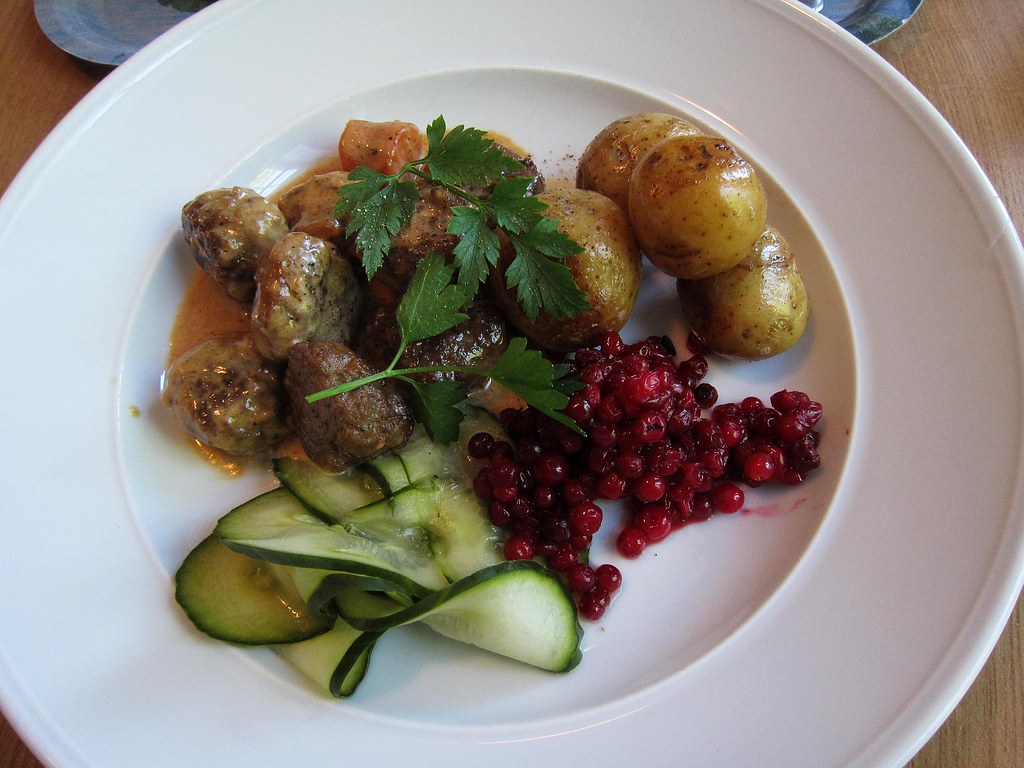
Swedish cuisine has its roots in the climate of the region, the long, harsh winters that are characteristic of the region led to the use of a variety of ingredients and preservation techniques that made it possible to survive harsh winters. It has also undergone influences from the neighboring regions that are evident in its present day cuisine.
The Scandinavian middle ages beginning in 1000AD, led to a use of variety of preservation techniques in order to preserve fish, one such technique was curing fish with salt, hence, salt became a prized commodity in the region and was traded. Gravlax is one of the popular dishes in the region, consisting of salt, sugar and dill. Earlier, it was cured by burying it into sand at the seashore, nowadays this practice is no longer used. The Swedish turnip, kalrot, is evident of the regions use of root vegetables in dishes due to harsh winters.
Smorgasbord, that become popular around the world after the 1939 New York World Fair, has its origins in the merchant and upper class traditions of 16th century Sweden, where appetizers were served before the main meal, during a gathering, known as branvinnsbord, these could be eaten standing. Eventually, smorgasbord started including warm dishes along with the cold dishes, and later it was served in hotels and in railway stations before the train arrived, in the 1912 Olympic Games, it was served as the main course.
The cuisine of the region was also influenced by the cuisine of the Ottoman Empire, certain popular dishes that are enjoyed in the country, such as kaldolmar, coffee and the famous dish of the country, the Swedish meatballs or kotbullar, have its origins in the Turkish cuisine of the 18th century.
King Charles XII of Sweden, invaded Russia in 1708, but was defeated in the Battle of Poltava in 1709, thus taking refuge in the Ottoman Empire, which was an enemy of Russia. There he travelled around the Empire, tasting the different dishes during his journey of five years, returning to his country in 1714, bringing his new acquired tastes with him. The King is said to have enjoyed coffee with meatballs, which were known as Kofte in the Empire and were made with ground beef or lamb mixed with spices. The earliest recipes for the dishes such as kaldolmar can be found in the book, Guide to Housekeeping for Young Women by Cajsa Warg, who served a family closely related to the King.
The local cuisine of the region, that was enjoyed by the peasants or was traditionally eaten, is known as Husmanskost, the word being derived from Husmans, meaning house owner. These dishes feature ingredients such as pork, fish, potatoes, many different kinds of herbs such as rosehips and different kinds of berries such as lingonberry, methods used to cook these dishes also are sometimes tedious such as roux making and long boiling. One such dish is the peas soup or Artsoppa.
Many different kinds of dishes were invented throughout the 19th and 18th centuries, that gave the cuisine its distinctiveness. Wallenbergare, named after Marcus Wallenberg or his wife Amalia Wallenberg is thought to have been invented by a chef named Julius Carlsson, who worked in the Cecile restaurant of Stockholm, when Marcus Wallenberg asked for a similar dish to the one he tasted on his business trip. Another story credits the invention of the dish to his father-in-law, Charles Emile Hagdahl, who was a famous Swedish Chef in the late 1800s. The dish consists of ground veal mixed with egg yolks and cream and fried as a patty, served alongside, mashed potatoes, peas and lingonberry jam.
A type of Swedish cheese, known as Vasterbotten, named after the town it was invented in, is said to have been invented by a maid named Ulrika Eleonara Lindstorm, in 1972, who was left alone to stir the curd of a traditional cheese but was interrupted and when came back to taste it, the taste was different but liked by the people around.
One popular Swedish street food dish is the tunnbroddsrulle, it consists of a sausage, mashed potatoes, mustard, and ketchup wrapped around a tunnbrodd or the Swedish semi-sweet flatbread that is made with yeast, and wheat or rye or barley. It was invented by Elov Bratfors, at his Loffes Grill, a hot dog and burger stand, he is also said to have been the first to use a mashed potato machine at his stand back then.
Hasselbackpotatis was invented in 1953 by a trainee student named Leif Elisson, who worked at Hasselbacken restaurant in Stockholm, the dish consists of roast potatoes that are sliced halfway through and can be garnished with breadcrumbs or cheese. Another invention of the 1950s that is popular in the country is the chocolate milk drink named Pucko, that was launched in 1954 by Arla Foods, Pucko has also become a slang term in Swedish for idiot.
The Prinsesstarta or the Swedish princess cake, that has become popular around the world, due to the furniture retail brand, IKEA, after meatballs, is a sponge cake that is decorated with powdered sugar and marzipan, giving it a dome like shape. It’s invention is credited to Jenny Akerstorm, who taught the three daughters of Prince Carl, Duke of Vastergotland and invented the cake in 1948. It came to acquire the name princess cake because it was a favourite of the princesses.
Thus, Swedish cuisine is a blend of local traditional ingredients and methods and influences from other regions notably the Ottoman Empire, all these influences come together to give the cuisine its unique and distinctive flavor.
Sources:
https://en.wikipedia.org/wiki/Swedish_cuisine
https://www.tasteatlas.com/50-most-popular-foods-in-sweden
https://en.wikipedia.org/wiki/Princess_cake
https://www.britannica.com/topic/smorgasbord
https://en.wikipedia.org/wiki/Pucko
 Historia